The first week has been the hardest so far. Trying to get accustomed to people speaking to you in Spanish (very fast Spanish) and having to understand AND respond was not an easy thing to do. I typically froze and stood there wide-eyed until someone else stepped in and responded to whatever had been said. I still do sometimes lol. Life here is so different than what I am used to. For one thing, city life is completely new, since I grew up in a small town and have only lived in Marietta for a year (and that’s not even city life). The Metro was a new experience, a fun one, too. It is so nice to be able to go almost anywhere you want in the city without having to drive. I would be much too terrified to drive around here. The roads are confusing, the drivers really good and really crazy, and the parking places impossibly small. I can definitely see why the cars are so small. Many people don’t even drive, and just walk everywhere. It is so nice to be in a country where people walk everywhere and cars actually stop for pedestrians. And it’s amazing to see people, families even, walking around at 10, 11, 12 o’clock at night. This is partly due to the fact that it doesn’t get dark until nearly 10:30, but even taking that into consideration, it’s not what I’m used to. Most of the people here are quite friendly, but most don’t smile as much as Americans, or rather Southerners, do. They seem to be more open about their feelings, and only smile when they really mean it. My favorite thing has definitely been the siesta. I love naps, and having one basically scheduled into my everyday routine has been lovely. Its so hot here, so I can understand why no one wants to be working or moving around during that time, and it also helps to further explain why everyone stays up so late. It has definitely been nice living in Spain, but I still have a lot of adjusting to do.
Thursday, July 26, 2007

First Impressions
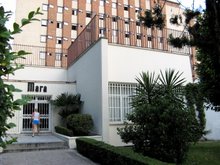
That amount of traveling is EXHAUSTING. I was so excited to go to Spain, but once I got there, I was almost too tired to appreciate my first few hours there. In the Atlanta airport, it was all nerves and anticipation. The flight over the Atlantic was the first big energy drain. When we landed in France seven to eight hours later, it was somewhat shocking to hear everyday, normal conversations and realize that I couldn’t understand a word. There wasn’t a whole lot to be explored in that airport, so instead you would see an ocean of students lying in the floor trying to sleep, while untold numbers of other people boarded their flights and flew away. The next flight was much shorter, but those two hours still managed to drain even more energy. The end of that flight was the most memorable part. The clouds were spectacular, pure white and full and fluffy, with every single one of them completely flat on the bottom, so that there was a horizon of clouds as far as the eye could see. Then, upon looking down, you could see the land below. It looked as though someone had laid a topographical map beneath us, the lines perfectly drawn. It was awesome. After the plane landed, there was the typical hustle and bustle about airports, claiming luggage, finding your ride, and so on. The bus ride from the airport to Mara, our colegio, showed more of Madrid, and served as a type of introduction to the country. Mara itself was quite cute, in my opinion at least, with everyone having their own dorm and bathroom, a good place for a tired traveler to crash. I was finally here, and it still didn’t seem real :) .
Wednesday, July 25, 2007
Getting Around in Spain
Bullfight
The Fights I saw were both interesting in their own way. In the first fight, two unusual events occurred. In one fight, the bull was let go. As I heard it, if the bull stumbles enough times before the picadores get summoned, the bull is allowed to go free. The other unusual incident was that there was a woman matador. While not as showy as the others, she did do a good, professional job of killing the bull cleanly. The second show I saw had a lot more showmanship. One of the banderilleros actually laid down and invoked the bull to charge almost directly over him, escaping unharmed. In either show, the amount of skill required was evident. Around this time of year, the bullfighting is in its off season, and the more inexperiences fighters are given the ring for practice and crowd exposure.
Los dos Museos
The Museo del Prado has been around in Madrid for a long time. Most of the artwork within hails from artists from centuries ago up until about the end of the 19th century. I loved having the chance to see some of the really old works, such as some original works from Van Eyck, Boticelli, and Velásquez. They also had an extensive collection by Goya, in cluding the very famous The Third of May 1808, which depicted the execution of the men who defended Madrid against the invasion of Napoleon.
The Museo de la Reina Sofia has several signifciant works as well, including Picasso's Guernica, for which the museum was created after the death of Francisco Franco. Picasso had vowed that the work would never come home to Spain until after the death of Franco. Franco outlived Picasso, but after a short spat between the Spanish government and the Metropolitan Museum of Art, the painting was turned over the museum after Franco's death. The work was comissioned by the republican resistance to Franco, and was meant to depict the bombing of the basque city of Guernica by the Germans, and act that Franco allegedly gave permission to.
Toledo
The oldest Toledo has been put at is as a Phoenecian settlement in 540BC. When the Romans found the city, it was already famous for its sword making and steel working abilities. Toledo also served as the capital of the Visigothic empire, starting with Leovigild.
Under the Arab caliphate, the city encountered what many consider to be its golden age. During this time, the Arabs allowed religious tolerance and free flow of ideas, a combination which made Toledo a center of knowlege that helped Spain gain respect among the other major European nations as an intellectual center. For centuries, Arabs, Christians, and Jews coexisted in the city, sharing ideas.
When Alfonso VI took Toledo, he made it the capital of his empire, and launched the first major Christian offensives of the Reconquista from there. However, when Philip II moved the capital to Madrid, the city slowly went into decline.
When I went to Toledo, I had the chance to see the Cathedral. I was mostly impressed by the sheer size of it. After asking a local where the cathedral was, he pointed our group in a certain direction. After only a couple minutes walk, we could see the spire of the cathedral dominating the sky ahead. The inside was just as impressive, with cielings which seemed to be at least 50 feet high. The decorations and paintings were absolutely stunning, some covered richly in gold and silver.
Ballet Naciònal de España
Having already seen one form of flamenco before, I was able to pick up on some of the different nuances of the ballet. There was much more movement and choreography involved in the ballet, naturally drawing from the traditional ballet performance of motion and carfully planned coordinated groups. This chief difference is what separates the ballet from the flamenco. Like flamenco, the dancers used their feet and hands to keep and command the ebb and flow of sound.
Overall, the lighting, costuming, and beauty of sound combined to make one of the better performances I have seen here in Spain.